
TL;DR: IV ketamine and SPRAVATO both target the glutamate system for treatment-resistant depression, but they differ in FDA status, delivery, insurance coverage, and dose flexibility, which is why the right choice depends as much on logistics as on biology.
Ketamine and SPRAVATO are often discussed in the same breath. Patients researching options for treatment-resistant depression frequently arrive at the clinic asking whether one is better than the other.
The honest answer is that they’re closely related but not interchangeable. SPRAVATO is the FDA-approved esketamine nasal spray. Traditional ketamine is delivered as an IV infusion and is used off-label for psychiatric conditions. Both work on the same fundamental receptor system in the brain, and both can lift symptoms within hours instead of weeks.
But the dose-response curves, the cost, the insurance picture, and the in-clinic experience look different enough that picking between them is a decision worth thinking through. This guide walks through what those differences mean for a real patient considering either treatment.
The Basic Distinction: IV Infusion vs. Esketamine Nasal Spray
Two forms of the same molecule
Ketamine is a single molecule that exists as two mirror-image forms, called enantiomers. The (S)-enantiomer is the esketamine that SPRAVATO uses. The (R) plus (S) mixture is what an IV ketamine infusion delivers.
Both forms cross the blood-brain barrier and bind to the NMDA glutamate receptor. The clinical pharmacology that matters most to patients is what each form does to the receptor, how quickly, and how long the effect lasts.
How IV ketamine is dosed
IV ketamine reaches peak plasma concentration within minutes of the infusion ending. The full racemic mixture binds NMDA receptors with predictable potency. That means the clinician can titrate the dose precisely to body weight and patient response.
Most KCSF infusion protocols start at 0.5 mg/kg over 40 minutes, with adjustments based on tolerance and target symptom relief. Our ketamine infusion therapy program follows this dose-titration approach across a standard induction series.
How SPRAVATO is dosed
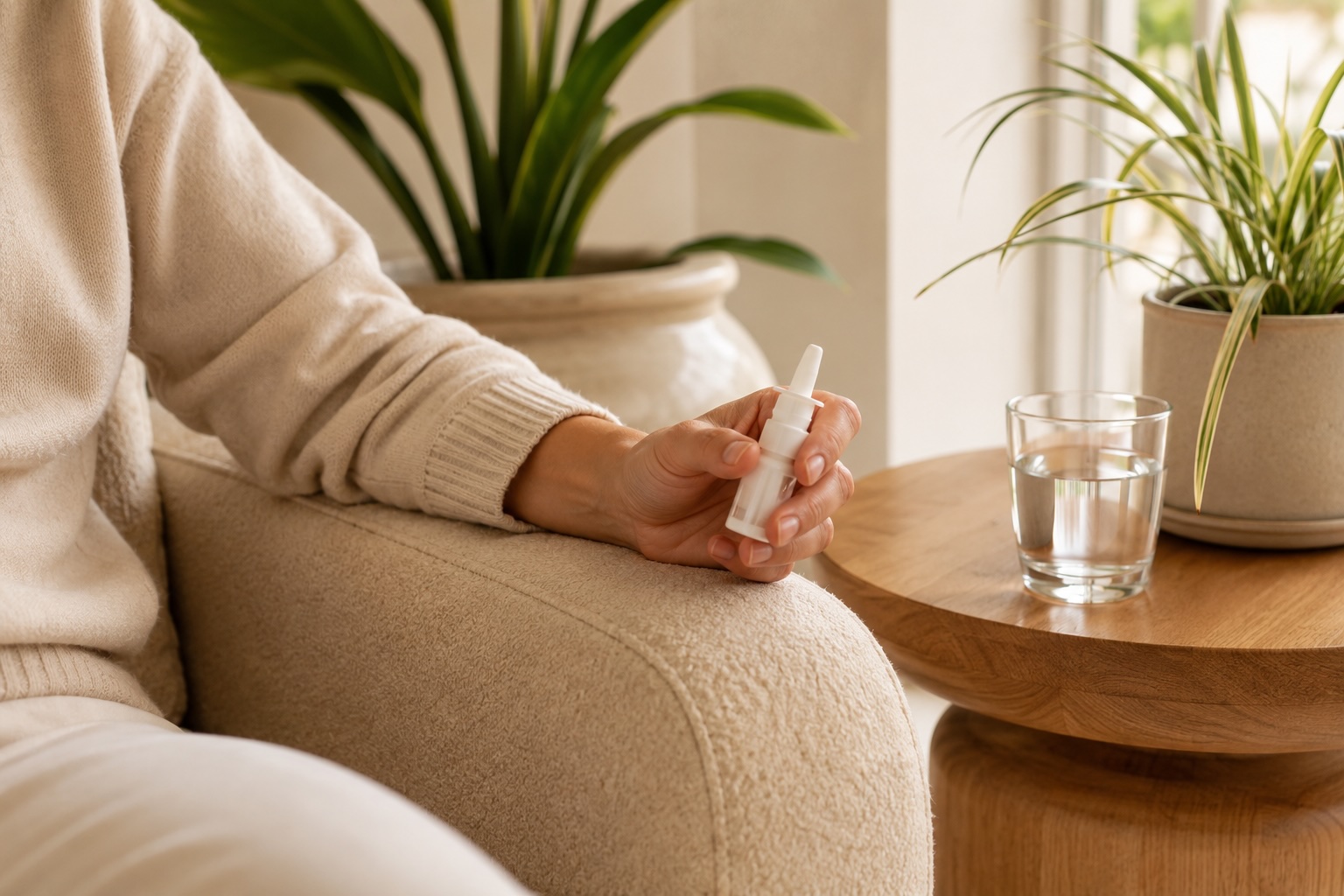
SPRAVATO is administered intranasally in 56 mg or 84 mg doses under direct observation in a certified treatment center. The nasal spray bypasses first-pass liver metabolism, which is why the absolute dose looks much smaller than an IV.
The dose isn’t titratable in the same way. The cartridges come in fixed strengths, and the clinician adjusts the regimen by changing the frequency or stepping between the two FDA-approved doses, not by mixing custom amounts.
Our SPRAVATO nasal spray program covers both the induction phase (twice weekly for four weeks) and the maintenance phase (once weekly or every other week, based on response).
FDA Status and What That Means for Patients
SPRAVATO is FDA-approved for depression
The FDA approved SPRAVATO in 2019 for treatment-resistant depression and in 2020 for depression with acute suicidal ideation. The original FDA approval letter for SPRAVATO spells out the indication and the REMS (Risk Evaluation and Mitigation Strategy) requirements.
SPRAVATO is the first and only FDA-approved esketamine product for depression.
IV ketamine is used off-label
IV ketamine, by contrast, is FDA-approved as an anesthetic. Its use for depression, anxiety, PTSD, OCD, suicidal ideation, and chronic pain is considered off-label.
Off-label is a normal and legal practice in medicine when peer-reviewed evidence supports the use, when a board-licensed clinician prescribes it, and when the dosing falls within a recognized clinical protocol. Decades of research and growing real-world data support IV ketamine for these psychiatric and pain indications.
Where the FDA distinction shows up
For patients, the FDA distinction shows up in three practical places:
- Insurance. SPRAVATO is far more likely to be reimbursed by commercial insurance and Medicare than IV ketamine.
- Dose flexibility. SPRAVATO comes in two fixed doses; IV ketamine can be titrated per patient.
- Paperwork. SPRAVATO requires REMS enrollment and on-site observation per FDA mandate; IV ketamine protocols are governed by anesthesia and psychiatry standards of care.
How They Work in the Brain
Both forms of ketamine block the NMDA glutamate receptor on inhibitory interneurons. The downstream effect is a surge of glutamate release in the prefrontal cortex, which activates AMPA receptors and triggers a cascade of synaptic protein synthesis.
The net result is rapid synaptic plasticity. That’s the most likely mechanism for the antidepressant effect seen within hours of dosing.
This is fundamentally different from how SSRIs work, which is by gradually raising serotonin levels over weeks. The glutamate-targeted mechanism is why ketamine and SPRAVATO can help patients who haven’t responded to multiple SSRI or SNRI trials.
The two delivery routes activate the same mechanism with different pharmacokinetic profiles. IV ketamine produces a steeper, more predictable plasma curve. SPRAVATO produces a slower onset and a longer plateau because of the slower nasal absorption. Both have similar peak effects on mood within 24 hours of dosing.
The Treatment Protocols Compared
The IV ketamine series
The standard IV ketamine induction series at most clinics, including KCSF, is six infusions over two to three weeks. Each session lasts about 40 minutes of infusion plus a recovery window.
After the induction series, maintenance is typically every two to six weeks depending on how long the response lasts. The dose is adjusted for each patient based on weight, tolerability, and target symptom relief.
Patients lie back in a private suite, often with a calming playlist and an integration specialist on standby.
The SPRAVATO series
The standard SPRAVATO protocol is twice weekly for four weeks (induction), then weekly for four weeks (consolidation), then weekly or every two weeks for maintenance.
Each session lasts two hours total. The actual nasal-spray administration takes a few minutes, but the patient remains under observation for two hours per FDA REMS requirements. The dose can step from 56 mg to 84 mg if response is partial.
The total time commitment
The total time commitment differs in a way that often surprises patients. An IV ketamine induction series runs six visits of about two hours each over two to three weeks. A SPRAVATO induction phase runs eight visits of two hours each over four weeks, plus four more during consolidation.
SPRAVATO is more frequent. IV ketamine is more concentrated.
Insurance, Cost, and Access
SPRAVATO and insurance coverage
This is where the choice often gets decided for real patients. SPRAVATO carries FDA approval, which means most commercial insurance plans and Medicare cover it (after prior authorization). The out-of-pocket cost for a SPRAVATO patient with insurance can be significantly lower than IV ketamine.
IV ketamine and out-of-pocket pricing
IV ketamine is off-label and not covered by most insurance plans. Patients pay out of pocket.
The Osmind platform helps file claims for partial reimbursement (especially for the psychiatric evaluation portion), but the full infusion cost is generally self-pay. KCSF’s introductory pricing for new ketamine clients starts at $89 per week billed monthly for three months, structured to make the induction series accessible without an all-at-once burden.
To review what each program costs and what’s bundled in, patients can review the pricing tiers before booking a consultation.
When insurance tilts the decision
For patients whose insurance covers SPRAVATO and who would otherwise pay out of pocket for IV ketamine, the insurance question alone often tilts the decision. But not always.
Some patients respond better to IV ketamine. Some find the IV route easier on their sinuses or nasal anatomy. Some prefer the more concentrated treatment schedule. Insurance matters, but it isn’t the only factor.
Side Effects and Safety Considerations
Both treatments share a similar side effect profile because they share a mechanism. The most common acute effects are transient dissociation (a feeling of being separate from the body or surroundings), blood pressure elevation during the session, mild nausea, and temporary blurred vision.
These typically resolve within an hour or two of the dose. Neither treatment is associated with the weight gain, sexual dysfunction, or emotional blunting that some patients experience on SSRIs.
Safety differences by delivery route
The main safety differences between the two come from the delivery route. IV ketamine requires venous access and continuous monitoring of vitals during infusion, which is why an anesthesia provider on staff matters. SPRAVATO is non-invasive but requires the same in-clinic observation window.
Patients cannot drive themselves home after either treatment. Both are contraindicated in patients with uncontrolled high blood pressure, certain cardiovascular conditions, untreated psychotic disorders, and a history of severe substance use disorder involving ketamine.
Who Tends to Do Better on IV Ketamine
IV ketamine often suits patients who:
- Have not responded to SPRAVATO or cannot tolerate the nasal-spray route
- Need precise dose titration because of body size, sensitivity, or partial response at fixed doses
- Have chronic pain conditions, treatment-resistant OCD, or PTSD where the broader evidence base for IV ketamine applies
- Are paying out of pocket or have FSA/HSA funds and prefer fewer, more concentrated sessions
- Live close enough to make a six-visit induction series practical over two to three weeks
Patients with severe nasal congestion, deviated septum, chronic sinusitis, or those who simply cannot tolerate nasal-spray administration also tend to do better with IV ketamine.
Who Tends to Do Better on SPRAVATO
SPRAVATO often suits patients who:
- Have a treatment-resistant depression diagnosis specifically and want the FDA-approved indication
- Have commercial insurance or Medicare that covers SPRAVATO
- Prefer needle-free administration
- Have a more flexible schedule that accommodates the twice-weekly induction phase
- Are looking for an established maintenance routine with documented long-term safety data
SPRAVATO also tends to suit patients who want their primary psychiatrist closely involved in the treatment, since SPRAVATO is typically administered alongside an oral antidepressant per FDA labeling.

Common Hybrid Approaches
Some patients start with one and switch to the other based on response. Others use a combined approach over the course of a treatment journey.
It’s not uncommon for a patient to complete an IV induction series, transition to SPRAVATO for maintenance under insurance coverage, and return to IV for occasional re-induction if a depressive episode breaks through. The two treatments are not mutually exclusive.
The right clinical team will discuss what makes sense based on response data and life circumstances rather than insisting on one product.
At KCSF, treatment decisions involve the certified nurse anesthesiologist, the medical director, and the patient’s outside psychiatrist when applicable. The first step is always a free consultation and a medical evaluation. Patients ready to talk through their options can schedule a consultation with the clinic team.
The Decision Isn’t Permanent
One thing patients often miss when researching online is that the choice between IV ketamine and SPRAVATO isn’t a one-time, irreversible decision. Many patients try one, experience partial response, and pivot to the other. Others use both at different phases of treatment.
The right framing is: which one makes the most sense as a starting point, given insurance coverage, schedule, condition profile, and patient preference? The treatment plan will evolve based on how the body responds.
For patients who have cycled through SSRIs, SNRIs, augmentation strategies, and possibly TMS or ECT without lasting relief, both IV ketamine and SPRAVATO offer a mechanism that targets the depression differently and works faster. The clinical question is which delivery route, dose flexibility, and treatment cadence fits the patient.
FAQ
Is SPRAVATO the same drug as ketamine?
SPRAVATO contains esketamine, one of the two mirror-image forms of the ketamine molecule. IV ketamine contains both forms (racemic ketamine). They work on the same NMDA glutamate receptor system but have slightly different binding profiles and dosing characteristics.
Will my insurance cover either treatment?
SPRAVATO is FDA-approved and typically covered by commercial insurance and Medicare after prior authorization, though out-of-pocket costs vary by plan. IV ketamine is off-label and generally not covered. The Osmind platform can help file claims for partial reimbursement (especially psychiatric evaluation components).
How quickly does each treatment work?
Both treatments can reduce depressive symptoms within hours of the first session. IV ketamine often produces noticeable shifts within 24 hours. SPRAVATO patients usually report meaningful improvement after the first one to two weeks of the induction phase.
Can I drive home after a session?
No. Both treatments produce transient dissociation and other effects that make driving unsafe for several hours after dosing. Patients need a ride home from every session.
How do I decide which one is right for me?
The decision involves several factors: your specific diagnosis, what treatments you have already tried, your insurance coverage, your schedule, your tolerance for nasal-spray administration, and your clinical team’s recommendation. The best starting point is a free consultation with a clinic that offers both treatments.